What Mental Illness Really Is... (and what it isn't) by Lucy Foulkes
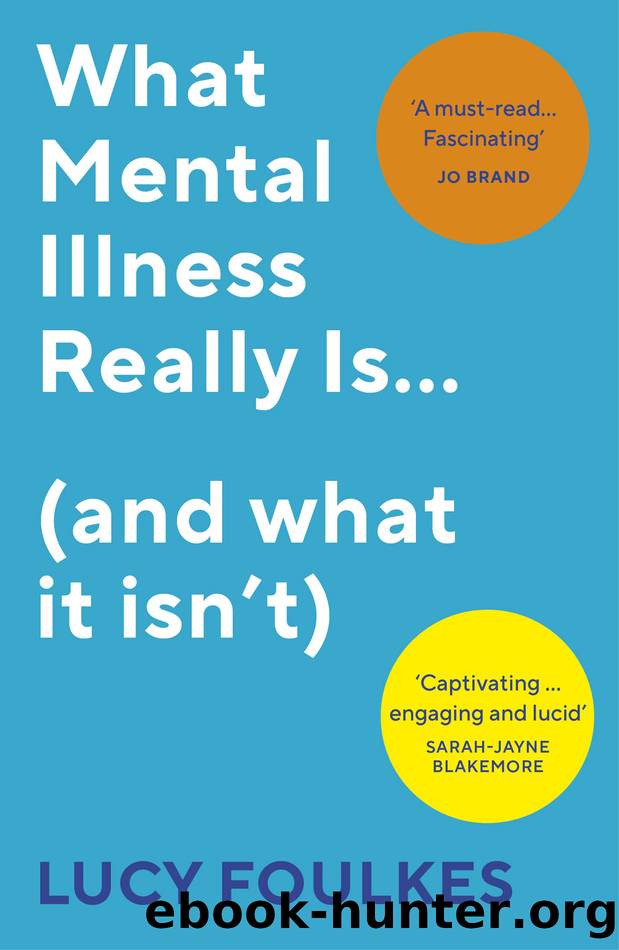
Author:Lucy Foulkes [Foulkes, Lucy]
Language: eng
Format: epub
ISBN: 9781529195064
Publisher: Random House
Published: 2022-04-21T00:00:00+00:00
Whatâs happening in the outside world?
The biological and psychological changes of adolescence donât occur in a vacuum. Adolescents are also contending with an external social world, one thatâs very different to what they experienced in childhood, and thatâs really important for understanding the onset of mental illness too. Something significant happens in the outside world around the start of adolescence: children move to secondary school or high school.
Around the start of secondary school, the responsibility for planning a young personâs social life starts to shift, from parents to the young person themselves. Parent-sanctioned playdates are replaced by adolescent-driven, unsupervised socialising. This is facilitated by mobile phones: many young people get their first phone around the start of secondary school, enabling more independent planning. This is all significant not just because it means more time spent with peers away from parents, but because they are a new set of peers. The cosy familiarity of primary-school classmates â who in many cases have remained a consistent group since the age of four or five â is suddenly replaced with a huge new pool of potential friends, enemies and rivals. Alongside their new-found independence, young adolescents are also navigating a new social hierarchy â the very concept of which barely existed to them before â and trying to figure out where their place in it might be.
Meanwhile, thanks to puberty, adolescents start to become sexually attracted to their peers. With the commencement of secondary school, adolescents can suddenly find themselves spending an awful lot of unsupervised time cooped up with the very peers that theyâre biologically most interested in. Assuming the young person can find someone who reciprocates their attraction (not always an easy task), the new levels of independence â the private communication via phones, the lack of parental supervision â means itâs now actually possible to have sexual relationships. (In the academic literature, a personâs first experience of sex is referred to as their âsexual debutâ, which I rather like, as to me it conjures up images of feather boas and jazz hands.) Maybe this goes reasonably smoothly: two teenagers are in a committed, trusting relationship; the sexual activity is consensual and private; the relationship ends mutually and maturely. But it rarely works out like this.
Sex can also trigger all kinds of potential stress. It might cause friction or arguments between friends; rumours might be spread; people might be pressured into having sex; there could be unwanted pregnancies or STIs. Compromising photos could get into the wrong hands: many âsextsâ are sent between teenagers without incident, but when intimate photos are shared widely across a school, for example, the psychological consequences can be severe. Even if the sex itself doesnât cause difficulties, relationship problems like being cheated on or being dumped can be humiliating or heartbreaking. In short, two key features of adolescence â biological interest in sex and a new, independent social life â can lead to the kind of stressful life events that sometimes spark off a mental illness.
The
Download
This site does not store any files on its server. We only index and link to content provided by other sites. Please contact the content providers to delete copyright contents if any and email us, we'll remove relevant links or contents immediately.
| Administration & Medicine Economics | Allied Health Professions |
| Basic Sciences | Dentistry |
| History | Medical Informatics |
| Medicine | Nursing |
| Pharmacology | Psychology |
| Research | Veterinary Medicine |
Periodization Training for Sports by Tudor Bompa(8278)
Why We Sleep: Unlocking the Power of Sleep and Dreams by Matthew Walker(6729)
Paper Towns by Green John(5195)
The Immortal Life of Henrietta Lacks by Rebecca Skloot(4593)
The Sports Rules Book by Human Kinetics(4398)
Dynamic Alignment Through Imagery by Eric Franklin(4220)
ACSM's Complete Guide to Fitness & Health by ACSM(4062)
Kaplan MCAT Organic Chemistry Review: Created for MCAT 2015 (Kaplan Test Prep) by Kaplan(4015)
Introduction to Kinesiology by Shirl J. Hoffman(3778)
Livewired by David Eagleman(3778)
The Death of the Heart by Elizabeth Bowen(3626)
The River of Consciousness by Oliver Sacks(3607)
Alchemy and Alchemists by C. J. S. Thompson(3526)
Bad Pharma by Ben Goldacre(3429)
Descartes' Error by Antonio Damasio(3282)
The Emperor of All Maladies: A Biography of Cancer by Siddhartha Mukherjee(3165)
The Gene: An Intimate History by Siddhartha Mukherjee(3100)
The Fate of Rome: Climate, Disease, and the End of an Empire (The Princeton History of the Ancient World) by Kyle Harper(3069)
Kaplan MCAT Behavioral Sciences Review: Created for MCAT 2015 (Kaplan Test Prep) by Kaplan(2988)
